Krugerrand Price and Value: How a Krugerrand Is Valued
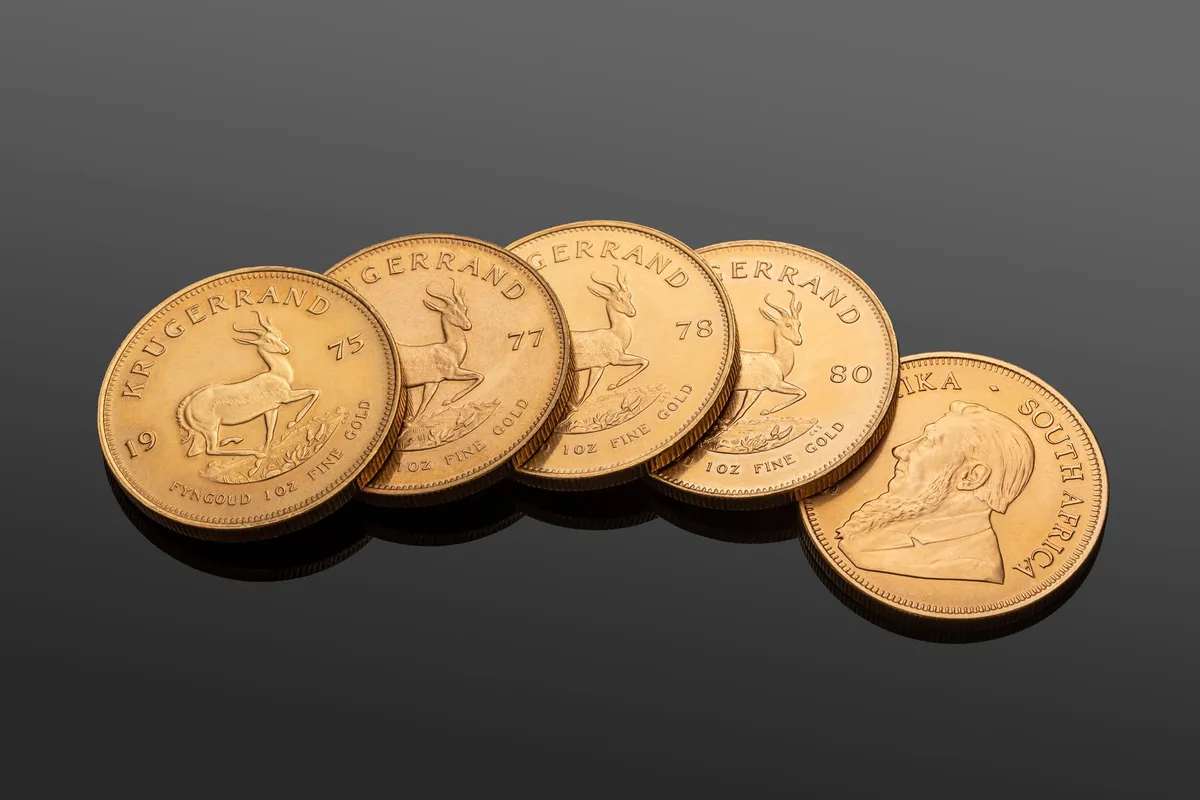
Ask what a Krugerrand is worth and the honest answer is: roughly the value of one troy ounce of gold, give or take a margin. Unlike rare coins, a standard Krugerrand is priced almost mechanically from the gold market. Understanding the few variables on top of that — premiums, spreads, special editions, condition and tax — is enough to judge whether a quoted price is reasonable, whether you are buying or selling.
The basic formula
A 1 oz Krugerrand contains exactly one troy ounce of fine gold, even though the coin weighs about 33.93 g because of its copper alloy. Its price is therefore built from two parts:
Coin price = gold spot price × 1 oz + premium
The spot price is the current market price for one troy ounce of gold, quoted continuously during trading hours and moving every minute. The premium is everything a seller adds on top: the cost of minting and distributing the coin, transport, insurance and the dealer’s margin.
For fractional coins, multiply the spot price by the gold content (0.5, 0.25 or 0.1 oz) and add a premium that is proportionally larger. You can follow the metal itself on our gold prices page.
Premiums and the buy/sell spread
Every dealer quotes two prices for a Krugerrand:
- an ask or selling price, at which you can buy the coin from them;
- a bid or buying price, at which they will buy it back from you.
The difference is the spread. For a widely traded coin like the Krugerrand, the bid is often close to the spot value of the gold, sometimes slightly below, while the ask sits above it. The round trip — buying and immediately reselling — therefore costs you the full spread.
Premiums are not fixed. They tend to be narrow when markets are calm and stock is plentiful, and they can widen considerably when demand surges, for example during financial stress, when retail buyers rush in and mints and dealers struggle to keep up. Buy-back prices can move the other way when many holders want to sell at once.
Because these figures change, the useful exercise is comparison: the same coin, the same size, the same delivery or collection terms, quoted at the same moment by different sellers.
Does the date matter?
For standard bullion Krugerrands, generally not. The design has hardly changed since 1967 and many millions of coins exist across all years, so a 1978 coin and a recent one usually trade at the same price. Dealers often sell them as “random year” or “mixed dates”.
There are exceptions:
| Type | How it is usually priced |
|---|---|
| Standard bullion, any year | gold value + bullion premium |
| Fractional bullion (1/2, 1/4, 1/10 oz) | gold value + higher premium per ounce |
| Proof coins in original packaging | may carry a collector premium, variable |
| Low-mintage or special issues | depends on collector demand |
| Damaged or cleaned coins | gold value, sometimes slightly below |
Proof Krugerrands, struck for collectors with mirror fields and frosted designs, can be worth more than bullion coins, especially in their original capsules and boxes with certificates. That extra value is not guaranteed: it depends on the year, the mintage and the presence of a buyer willing to pay for it. Outside the collector market, a proof coin may simply be bought for its gold.
Condition
Krugerrands are struck in 22-carat gold, which makes them relatively robust. Normal light wear from handling rarely affects the bullion price. What can reduce value is:
- visible damage such as deep scratches, dents or edge knocks;
- signs of jewelry mounting, holes or solder;
- aggressive cleaning or polishing.
A badly damaged coin is typically bought as scrap gold, valued strictly on its weight and purity, which can mean a lower bid than for a clean coin. Keeping coins in capsules or tubes avoids most of these problems.
Authenticity is also part of condition in the broad sense. A buyer will check weight (about 33.93 g), diameter, thickness and appearance, and may use electronic or ultrasonic testers. Coins with doubtful characteristics may be refused or valued only after assay.
Taxes
Tax treatment varies a great deal by country, and sometimes by region within a country. In some places investment gold is exempt from value-added tax or sales tax; in others tax may apply to purchases, or only to certain coins or amounts. Gains on resale may be taxable as capital gains, with rules that differ depending on where you live and how long you held the coin.
Because the Krugerrand has no face value, it does not benefit from rules that some countries reserve for their own legal-tender coins. This is general information only; check the rules that apply to your own situation.
Estimating the value yourself
To get a fair idea of what a Krugerrand is worth today:
- Check the gold spot price per troy ounce in your currency.
- Multiply by the fine gold content: 1, 0.5, 0.25 or 0.1 oz.
- Look at several dealers’ bid prices for the same size. This is what the coin is realistically worth if you sell now.
- Look at ask prices to see what replacing it would cost.
- Set aside special cases: proofs, sets in original packaging or damaged coins need a specific quote.
The result is a range rather than a single number: the bid gives the floor, the ask the ceiling. For background on the coin itself, see our page on Krugerrand gold coins, and for practical buying steps, our guide on how to buy gold coins.
Key points
- A Krugerrand’s value tracks the gold price for its fine content: 1 oz for the standard coin.
- Premiums and spreads add a margin that changes with market conditions.
- Dates rarely matter for bullion coins; proofs and special issues are priced separately.
- Damage or heavy cleaning can push a coin down to scrap value.
- Taxes depend on the country and must be checked locally.
This article may contain partner links. They never influence what we write.